

Vietnam Ecommerce 2026: Why Brands Need to Build Beyond Marketplaces
As Shopee and TikTok Shop dominate Vietnam’s ecommerce landscape, businesses face a growing challenge: how to protect profitability, build stronger customer relationships, and create sustainable growth beyond third-party marketplaces.
Vietnam’s ecommerce market continues to expand, but the opportunities and challenges facing online businesses are changing.
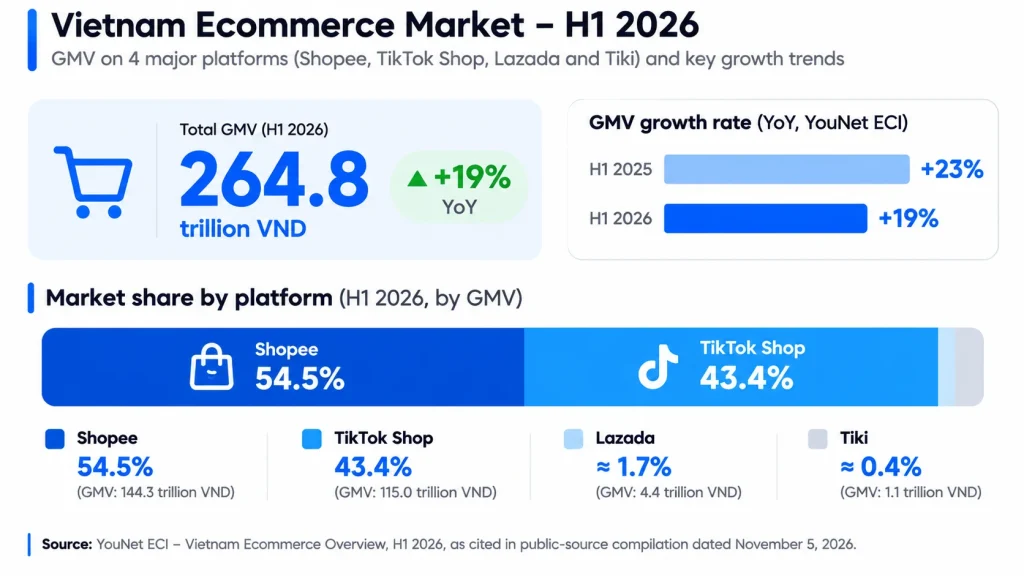
According to YouNet ECI’s H1 2026 ecommerce market findings, the combined gross merchandise value (GMV) of Vietnam’s four major ecommerce platforms—Shopee, TikTok Shop, Lazada, and Tiki—reached approximately VND 264.8 trillion (US$10+ billion), representing 19% year-over-year growth.
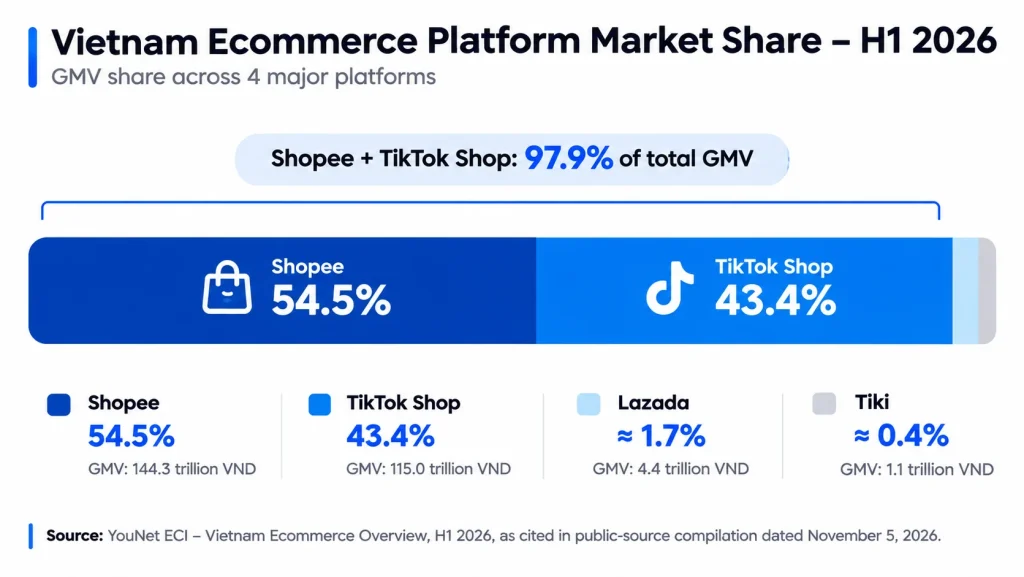
Even more notably, Shopee and TikTok Shop together accounted for nearly 98% of the market’s GMV across these four platforms.
These figures highlight two important realities.
First, ecommerce remains a significant growth opportunity for businesses in Vietnam.
Second, a substantial share of online transactions is concentrated within just a few platforms.
For brands and retailers that depend heavily on marketplace sales, this raises an increasingly important question:
How can businesses continue benefiting from major ecommerce platforms while gaining greater control over their customer relationships, operating costs, and long-term growth?
At YouNet Social, we believe the answer is not necessarily to leave marketplaces behind. Instead, businesses should consider a more balanced approach that combines marketplace selling with their own branded ecommerce and community experiences.
That is where Hybrid Commerce and Community Commerce come in.

Vietnam’s Ecommerce Market Is Growing, but Growth Is Becoming More Competitive
Vietnam remains one of Southeast Asia’s important ecommerce markets, supported by widespread digital adoption, online shopping habits, and the growing influence of video-driven commerce.
According to YouNet ECI, the combined GMV of Shopee, TikTok Shop, Lazada, and Tiki reached VND 264.8 trillion in the first half of 2026, up 19% from the same period in 2025.
However, the reported growth rate was lower than the 23% recorded in H1 2025.
This suggests that while ecommerce continues to expand, the pace of growth is moderating.
A separate estimate from Metric placed the four platforms’ combined GMV at VND 291.6 trillion, up 44.11% year over year.
The difference between these estimates may reflect variations in measurement scope and methodology. Since the available public-source compilation does not fully reconcile the figures, they should not be treated as interchangeable.
For consistency, this article uses YouNet ECI as its primary market data reference.
What does this mean for ecommerce businesses?
A growing market does not guarantee growing profits for every seller.
As more businesses compete for visibility, attention, and conversions, sellers must manage advertising expenses, promotions, marketplace fees, and fulfillment costs carefully.
The key question is no longer simply how much revenue a business generates.
It is how efficiently that revenue is generated—and how much long-term customer value the business retains.
Shopee and TikTok Shop Control Nearly 98% of GMV Across Vietnam’s Four Major Marketplaces
One of the most significant findings from H1 2026 is the concentration of e-commerce activity.
According to the YouNet ECI figures referenced in the market compilation:
| Platform | H1 2026 GMV | Market share | YoY growth |
|---|---|---|---|
| Shopee | VND 144.3 trillion | 54.5% | +15% |
| TikTok Shop | VND 115.0 trillion | 43.4% | +27% |
| Lazada | VND 4.4 trillion | ~1.7% | -23% |
| Tiki | VND 1.1 trillion | ~0.4% | +33% |
Market shares are calculated within these four platforms. Lazada and Tiki figures are cited through secondary reporting based on YouNet ECI data.
Together, Shopee and TikTok Shop accounted for approximately 97.9% of the combined GMV.
For brands, these platforms offer clear advantages: large audiences, established purchasing behavior, integrated payments, and extensive fulfillment ecosystems.
However, relying on one or two platforms for most sales can also expose businesses to several risks.
Platform policy changes. Adjustments to commission structures, seller programs, or participation requirements may affect operating costs.
Algorithm dependency. Product visibility and customer acquisition can change as marketplace recommendation systems evolve.
Increasing competition. Sellers often compete through pricing, promotions, advertising, and platform-specific campaigns.
Limited direct customer relationships. Customer interactions and data access are governed by marketplace policies, potentially restricting how brands develop their own long-term engagement programs.
These challenges do not make marketplaces less valuable.
They highlight why businesses should avoid placing their entire ecommerce strategy in the hands of a single sales channel.
The goal is not to abandon marketplaces. It is to build a business that can grow beyond them.
Vietnamese Consumers Are Becoming More Selective
Market competition is only one side of the equation.
Consumer behavior is also evolving.
According to the YouNet ECI consumer findings referenced in the H1 2026 market compilation, the ecommerce Consumer Confidence Index (eCCI) declined from 127 points in Q1 to 122 points in Q2 2026.
The reported survey findings also identified several factors influencing purchasing decisions:
- 68% of respondents considered price.
- 53% considered promotions.
- 52% considered product quality.
Additionally, 60% of Gen Z respondents and 43% of Gen Y respondents reported maintaining or reducing their online spending in Q2 compared with Q1 2026.
These findings suggest that shoppers are paying closer attention to how and where they spend their money.
For businesses, this creates a challenge.
Competing through discounts and advertising alone may become increasingly difficult to sustain.
Brands need to offer customers more compelling reasons to choose them, including trustworthy product information, helpful advice, reliable service, authentic reviews, and meaningful experiences.
Why trust matters more than ever
When consumers become more cautious, the relationship between a brand and its customers becomes increasingly important.
A brand that helps customers make informed purchasing decisions can differentiate itself beyond pricing.
Educational content, customer discussions, product demonstrations, and verified reviews can all contribute to a more transparent shopping experience.
This creates an opportunity for businesses to connect e-commerce with ongoing customer engagement rather than treating each purchase as an isolated transaction.

Marketplace Selling Costs: Revenue Growth Does Not Always Mean Profit Growth
Major ecommerce platforms make it easier for businesses to reach customers and process transactions.
However, sellers must account for the costs associated with operating on these platforms.
Depending on the platform, product category, seller classification, and optional programs, these expenses may include commissions, transaction fees, advertising, promotions, fulfillment, and returns.
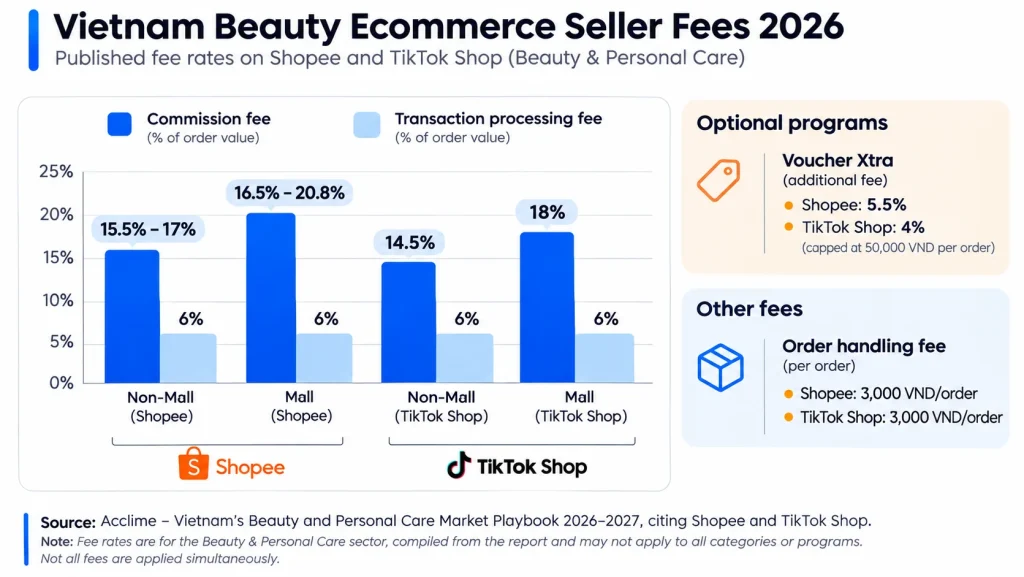
The Vietnam’s Beauty and Personal Care Market Playbook 2026–2027 published by Acclime provides a useful example of reported marketplace fee structures for Vietnam’s Beauty & Personal Care sector.
| Fee category | Shopee | TikTok Shop |
|---|---|---|
| Non-Mall commission | 15.5–17% | 14.5% |
| Mall commission | 16.5–20.8% | 18% |
| Transaction processing | 6% | 6% |
| Optional Voucher Xtra | 5.5% | 4%, subject to a per-order cap |
| Order handling | VND 3,000/order | VND 3,000/order |
Source: Acclime, Vietnam’s Beauty and Personal Care Market Playbook 2026–2027. These reported rates are sector-specific, have not been independently confirmed against official November 2026 fee schedules, and do not necessarily apply to every seller or order. Optional fees should not be treated as mandatory.
For businesses operating on thin margins, these expenses can become a major factor in overall profitability.
But there is another consideration.
An independent ecommerce channel also requires investment in technology, customer acquisition, payment processing, logistics, and customer support.
So the question shouldn’t be whether selling through an owned platform is cheaper than selling through a marketplace.
A more useful question is:
Which combination of channels can generate profitable sales, retain customers, and create sustainable long-term value?
Hybrid Commerce: Combining Marketplace Reach With Brand Ownership
At YouNet Social, we believe that third-party marketplaces and owned ecommerce platforms can complement each other.
This approach can be described as Hybrid Commerce.
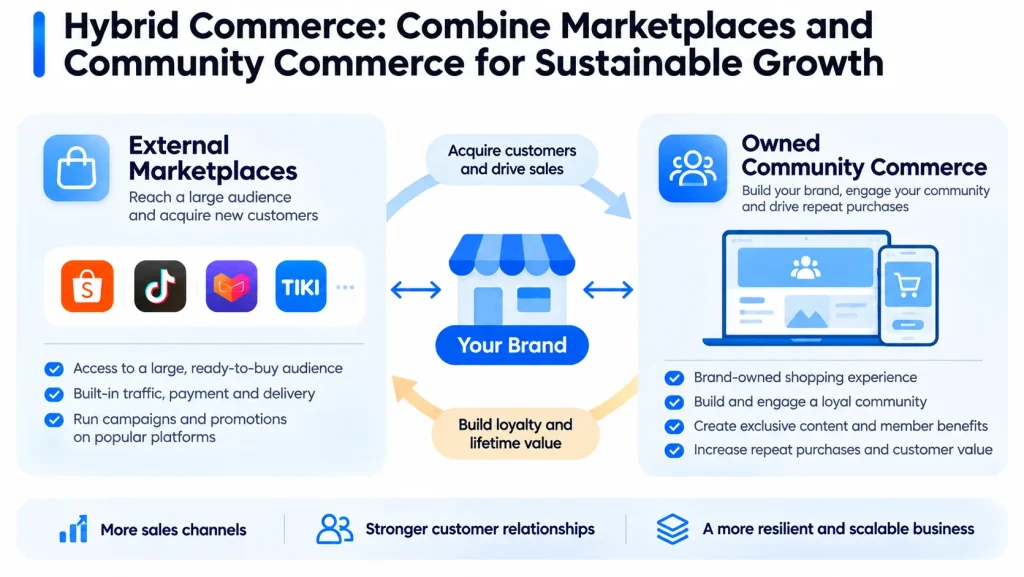
Instead of relying exclusively on marketplaces, businesses combine external sales channels with an ecommerce experience they operate under their own brand.
Each channel plays a different role.
External marketplaces: Reach and customer acquisition
Platforms such as Shopee and TikTok Shop can help businesses reach established shopping audiences, discover new customers, and participate in high-traffic campaigns.
They remain valuable channels for product discovery and transactions.
Owned ecommerce: Engagement and long-term relationships
A branded ecommerce platform can help businesses develop a more distinctive customer experience.
It may support direct engagement, membership programs, personalized content, customer support, and repeat purchasing opportunities.
It also provides greater flexibility to design the customer journey, subject to applicable privacy and data protection requirements.
The objective is not to immediately move all marketplace sales to an owned platform.
A more practical strategy is to start with an existing customer segment, test a focused product offering, and gradually expand based on measurable business performance.
This creates opportunities to diversify revenue while continuing to benefit from established marketplaces.
Community Commerce: Turning Customer Engagement Into Business Opportunities
Building an ecommerce website is one thing.
Giving customers a reason to return is another.
A conventional online store is primarily designed around product discovery and transactions.
But customers may have interests and needs that extend far beyond purchasing.
They may want advice, product education, discussions with other customers, practical demonstrations, or access to exclusive content.
This is where Community Commerce becomes particularly relevant.
Community Commerce brings together online communities, content, customer interactions, and ecommerce within a connected experience.
Instead of treating shopping as a standalone activity, businesses can make it part of an ongoing relationship with their customers.
Example: A Vietnamese beauty brand
The beauty industry provides a useful example.
According to the YouNet ECI figures referenced in the market compilation, Vietnam’s online beauty category, excluding personal care, generated approximately US$1.31 billion in GMV during H1 2026, up 12% year over year.
Shopee accounted for 52.6% of this category’s reported GMV, while TikTok Shop represented 46.5%.
Imagine a skincare brand that already sells through these platforms.
Rather than replacing its marketplace presence, the brand launches an owned community where customers can:
- Explore skincare tutorials and educational content.
- Watch product demonstrations and live shopping sessions.
- Ask questions and exchange experiences.
- Read product ratings and verified customer reviews.
- Discover and purchase relevant products.
- Share feedback after using those products.
Over time, these interactions can form a continuous customer journey:
Community → Content → Product Discovery → Shopping → Reviews → Community
Helpful content supports discovery.
Customer experiences generate reviews and discussions.
Those contributions can create additional value for other community members.
When implemented effectively, this model may help businesses strengthen engagement, encourage repeat purchases, and develop longer-lasting customer relationships.

Community Commerce beyond beauty
The same approach can work for other industries.
Retail and D2C brands can connect product education with shopping.
Educational organizations can combine learning communities with digital products and resources.
Businesses with distributors or partners can develop specialized multi-seller marketplaces.
Professional communities can offer relevant products and services within their own ecosystems.
The starting point should always be the community’s needs—not simply the number of products available for sale.
How YouNet Social Helps Businesses Build Community Commerce
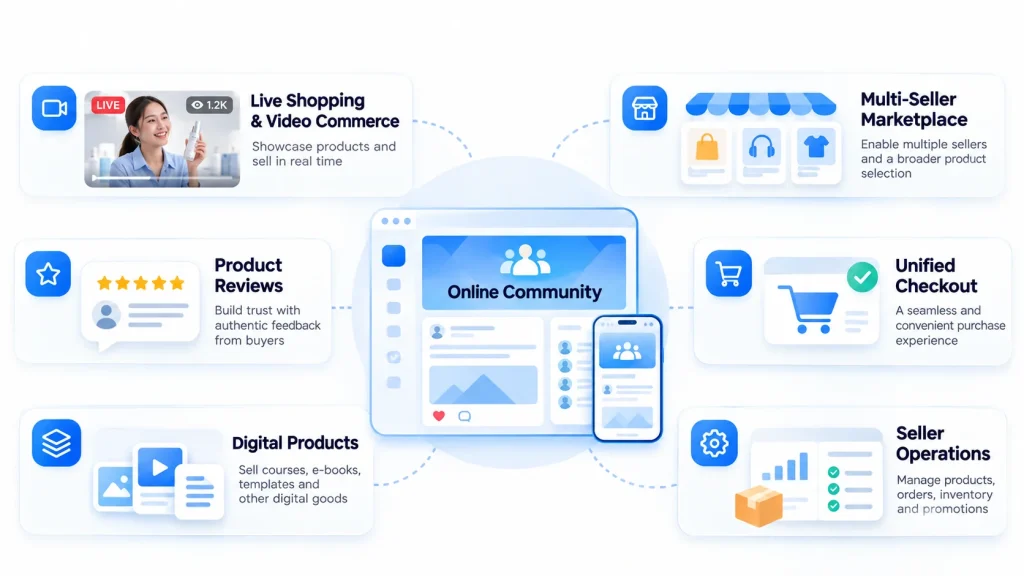
At YouNet Social, we help businesses explore and implement online community solutions that connect engagement, content, and commerce.
Through solutions such as phpFox Advanced Marketplace, organizations can develop e-commerce experiences within their community platforms.
Relevant capabilities include:
Live Shopping and Video Commerce
Businesses can showcase products through Clips and Live Videos, allowing community members to discover products while engaging with content.
Multi-Seller Marketplace
Organizations can support multiple sellers within one ecosystem, enabling customers to purchase products from different stores through a unified shopping cart and checkout experience.
Product Ratings and Reviews
Product reviews and Verified Buyer indicators can help customers evaluate products using feedback from other purchasers.
Seller Management
Sellers can manage products, inventory, orders, shipping information, and promotional activities.
Digital Products
Communities can offer ebooks, templates, educational resources, and other downloadable products.
For businesses operating in Vietnam and Southeast Asia, assess additional requirements such as local payment gateways, logistics providers, CRM or ERP integration, reporting, and specialized workflows.
Some requirements may involve additional integration or custom development.
YouNet Social can work with businesses to evaluate their operating model, define implementation requirements, and identify a practical development roadmap.
Start Small, Measure Performance, and Scale With Confidence
Not every business needs to launch a large marketplace immediately.
A focused pilot is often a more practical starting point.
Businesses can begin by identifying a customer segment with clear interests, selecting a limited product range, and introducing content-driven shopping experiences.
Then evaluate performance using measurable indicators.
| KPI | What it measures |
|---|---|
| Revenue by Channel | Revenue contribution from marketplaces and owned channels |
| Customer Acquisition Cost | Cost of acquiring new customers |
| Conversion Rate | Percentage of visitors who complete a purchase |
| Repeat Purchase Rate | Percentage of customers who buy again |
| Customer Lifetime Value | Estimated long-term customer value |
| Community Engagement | Member activity and content interactions |
| Channel Profitability | Profitability after channel-related costs |
Some metrics may require additional analytics tools or integrations depending on the implementation.
Two particularly useful indicators are the share of revenue generated through owned channels and the repeat purchase rate.
Together with channel profitability, these metrics can help businesses evaluate whether they are developing a more diversified and sustainable ecommerce operation.
Once the model demonstrates value, businesses can expand their product offerings, seller network, community programs, and supporting technology.
The Future of Ecommerce Is About More Than Selling Across Multiple Channels
Vietnam’s H1 2026 ecommerce data highlights a market that continues to grow while becoming increasingly concentrated around major platforms.
At the same time, consumers are showing signs of more cautious purchasing behavior.
For businesses, these developments reinforce the importance of looking beyond short-term sales performance.
Marketplaces will continue to play a significant role in ecommerce across Vietnam and Southeast Asia.
However, businesses can also benefit from exploring channels that offer greater flexibility in customer engagement, brand experience, and long-term relationship development.
Community Commerce is not a replacement for marketplaces. It is a complementary approach that connects content, communities, and shopping within a brand-owned experience.
Instead of focusing exclusively on acquiring the next order, businesses can start building communities that give customers meaningful reasons to return.
Explore Community Commerce Opportunities With YouNet Social
Is your business heavily dependent on Shopee, TikTok Shop, or other ecommerce marketplaces?
Are you considering an owned ecommerce platform but unsure where to begin?
Or do you already have an active customer community and want to explore new commerce opportunities?
YouNet Social can help you evaluate Hybrid Commerce and Community Commerce strategies, identify suitable technology solutions, and plan an implementation approach aligned with your business goals.
Explore Community Commerce Solutions With YouNet Social
Sources and Research Notes
- YouNet ECI — Vietnam Ecommerce Market Overview, H1 2026. Figures referenced through publicly available secondary reporting.
- Metric — Vietnam Ecommerce Report, H1 2026, published July 29, 2026.
- Acclime — Vietnam’s Beauty and Personal Care Market Playbook 2026–2027, including reported marketplace fee structures.
- Cimigo, VnEconomy, and Vietnamnet — Secondary market commentary and reporting referencing YouNet ECI and Metric.