

Content Engine
Turn market signals into creative decisions and measurable learning.
Connect brand, category and market insights with human creativity, AI-assisted production and content prediction. Activate approved ideas, validate real performance and carry what you learn into the next campaign.
Your content team needs evidence it can act on and learning it can retain.
Brand teams and agencies often work with scattered market insights, subjective feedback and disconnected performance reports. Content gets produced and published, but it is difficult to explain why an idea was chosen, whether it met expectations and what should change next.

Bring intelligence, creative options, decisions and results into one connected process.
For brand and marketing teams, creative agencies and content operations teams that need a shared basis for decisions, scalable exploration and continuity across campaigns.
Content Intelligence
Identify promising content directions from brand, category and market signals. Explore consumer reactions, content pillars and patterns that can inform creative briefs.
Creative Production Support
Develop options through human creativity, with an optional Content Engine to support generation and exploration. Use brand guidelines, product information and campaign context to shape the work.
Content Prediction
Estimate performance potential to support comparison and discussion. Treat predictions as additional signals alongside brand context and creative judgment.
Content Decision & Activation
Give brand and agency teams a shared evidence base to review, refine and approve options before activation through agreed channels.
Performance Validation
Evaluate actual performance against agreed benchmarks, objectives and measurement windows. Compare predicted and observed results.
Creative Memory & Learning
Retain content context, decisions, results and lessons. Bring successful directions, missed predictions and breakthrough ideas into the next cycle.
A connected loop from insight to creative learning.
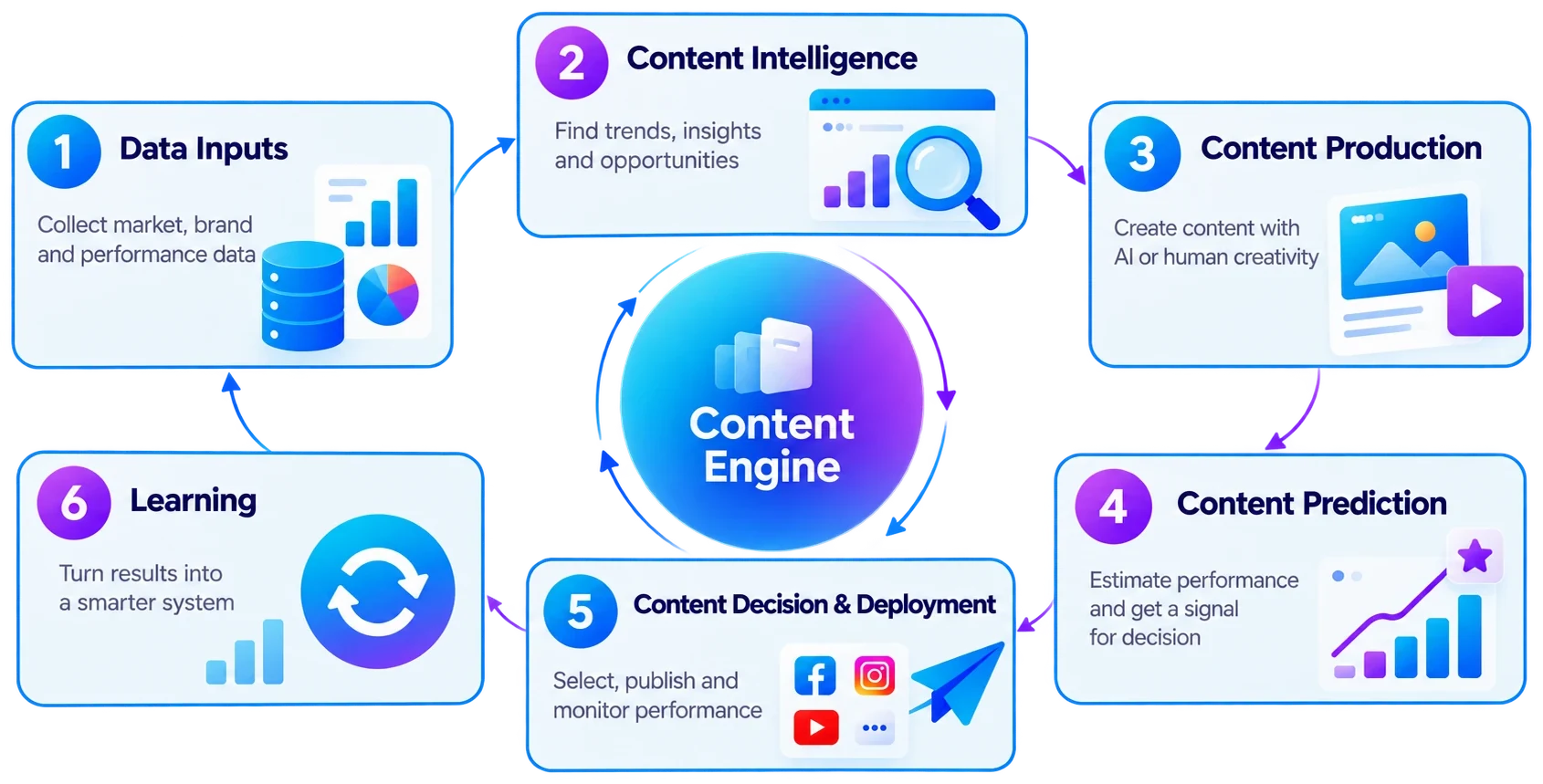
- 01Understand
Analyze brand, category and market data to identify directions worth exploring.
Output: an evidence-informed creative brief
- 02Create
Develop content directly with your creative team, or use an optional Content Engine followed by human refinement.
Output: reviewed content options
- 03Evaluate
Use prediction signals and creative judgment to assess options while preserving space for new ideas.
Output: a shortlist and exploration candidates
- 04Decide & Activate
Brand and agency teams approve content and activate it according to the agreed campaign plan.
Output: deployed content with recorded decisions
- 05Validate
Measure real results within the agreed window and compare them with benchmarks and predictions.
Output: validated performance findings
- 06Learn
Feed results into intelligence, prediction improvement and Creative Memory.
Output: reusable knowledge for the next brief
AI informs. People create and decide. Real results shape the next cycle.
Give creativity more evidence and room to explore.
Intelligence helps teams see what has worked. Prediction adds a signal about what might work next. Your creatives can still develop ideas outside those patterns, and your team makes the final decision.
Set an exploration allocation that fits your brand, objectives and appetite for experimentation. Evaluate unconventional ideas through real tests, not prediction scores alone.
Content decisions built on shared evidence
Evidence-informed Creative Briefs
Bring category patterns and audience reactions into a brief without narrowing every idea to what has worked before.
Brand and Agency Alignment
Discuss creative options using shared context, benchmarks and prediction signals, with clear approval responsibility.
Content Option Exploration
Explore variations through human creativity and optional AI support; review each option for brand fit and meaningful differentiation.
Campaign Learning and Continuity
Capture why ideas were chosen, how they performed and what the team learned so knowledge remains useful when teams change.
Agree on what a HIT means before you publish.
Choose the objective, primary metrics, relevant benchmark and evaluation period before activation. Review attention, engagement, conversation and qualified audience response according to the campaign’s purpose. Connect to business outcomes when the data allows.
Did the content meet the agreed criteria?
How did actual performance compare with prediction?
What should the next cycle change?
Every campaign should leave your team with more knowledge.
Retain content directions, creative options, approval rationale, performance results and lessons in a reusable record. Capture breakthroughs as well as predictable winners, and bring this context into future briefs and model reviews.
Connect with your marketing ecosystem.
Connect available social and campaign data, brand assets, creative workflows and performance reporting around the content learning loop. Integration scope is designed around your existing systems and available data access.
Evidence for creativity, with people in charge
Start with brand, category and consumer evidence to create a clearer brief.
Keep human development, refinement and final approval throughout the process.
Evaluate content using criteria set before activation.
Preserve results and creative lessons across campaigns and team changes.
Questions about the approach
Does every idea need to be AI-generated?
No. Human creatives can work directly from intelligence, or use an optional Content Engine to explore and refine options.
Does the prediction score decide what gets published?
No. It adds evidence to the discussion. Your team considers brand context, creative judgment and experimentation goals before approval.
Can the solution guarantee a HIT?
No. Success is defined in advance and validated with observed market results. Predictions are estimates, not guarantees.
Can we start with a focused pilot?
A proposed pilot can cover one brand or campaign, with agreed inputs, measurement criteria, human approvals and a learning review. Scope is defined together.
What APIs are best for building an AI-powered content creation tool for text, images, and video?
A practical setup is OpenAI for text and images, combined with Google Veo or Runway for video generation. For larger-scale systems, you can extend the stack with workflow automation, asset storage, brand guidelines, human approval, and multi-channel publishing to create a complete AI-powered content production pipeline.

Build a content process that learns with every campaign.
Discuss how to connect market intelligence, creative development, prediction and performance learning around your brand’s content workflow.